
The cocktail cherry gold standard.
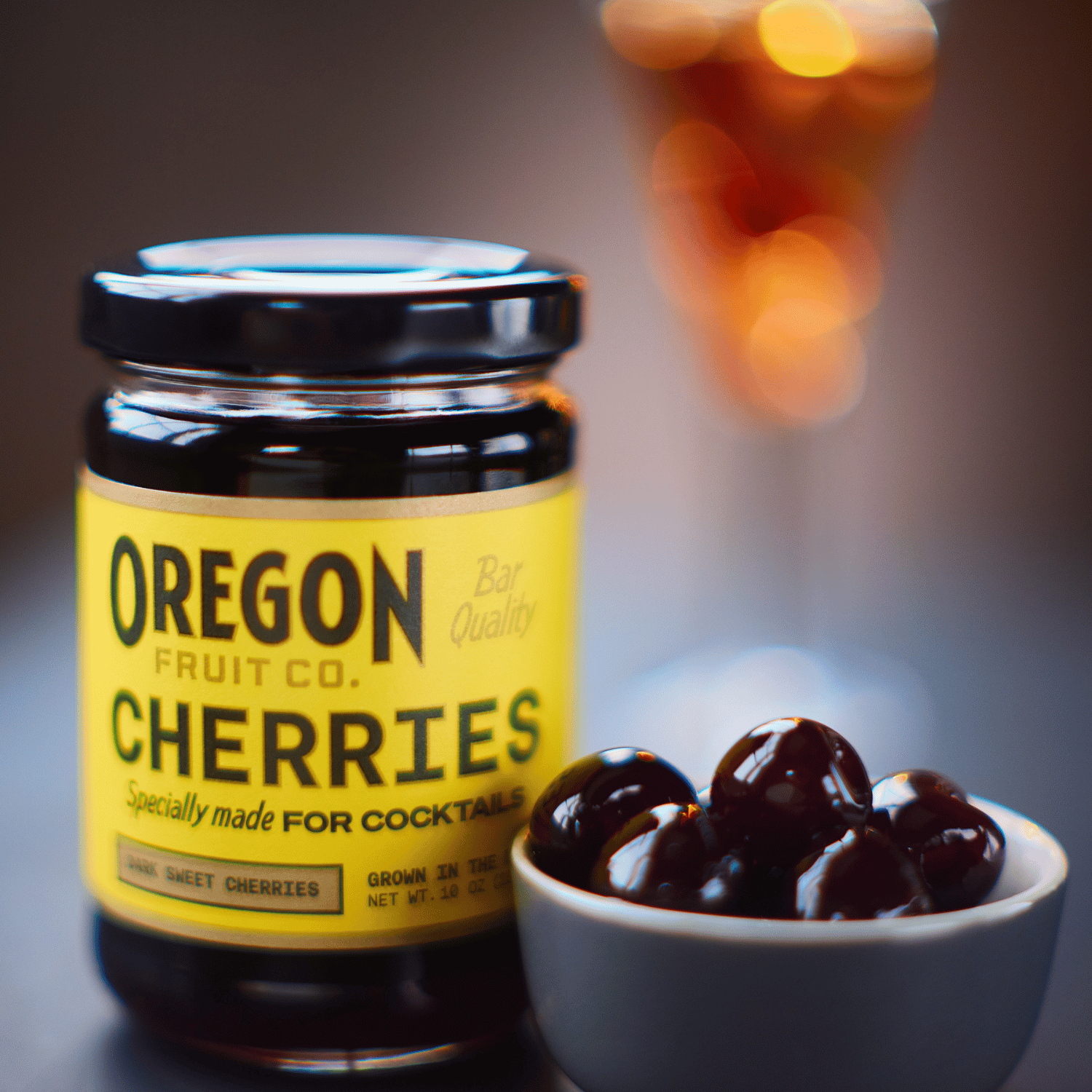
There is a jar behind the bar at every serious cocktail program in the country. The cherries inside are nearly black, suspended in syrup so thick it barely moves when you tilt the glass. Pull one out and it clings to the spoon. Bite into it and there's a snap, then a slow release of something bittersweet and complex.
This is the Italian-style cocktail cherry. The gold standard of the garnish world for two decades — made from real fruit, preserved in its own thick syrup without artificial color or flavoring, with a depth that earns its place in the glass. Craft bartenders discovered it in the mid-2000s and never looked back.
The marasca cherry, native to the Dalmatian coast, is an assertive fruit — bittersweet, intense, almost medicinal in its complexity. For the right cocktail in the right hands, it is exactly right. It is also a connoisseur's cherry. A bold flavor profile that narrows its use cases.
What the bar world was really reaching for — even if it took a while to say so — was everything the Italian standard understood about format and integrity: real fruit, real syrup, honest preservation. With a flavor that lets the cherry lead. Sweet. Fruit-forward. Clean.
Nobody had made that product in the United States. Why not?
A brief, damning history of the American maraschino cherry
It started with good intentions. Oregon had an abundance of Queen Anne cherries and no efficient way to get them into the maraschino market — buyers rejected them because American varieties turned soft in European-style brine. Ernest H. Wiegand, a professor of horticulture and food science at what is now Oregon State University, began the maraschino research in 1925, working at it for six years. His breakthrough was calcium salts, added to the brine to firm the fruit. He also added oil of bitter almond to approximate the flavor of the marasca pit that American cherries naturally lacked.
It worked. Oregon cherries were suddenly viable. An industry was born.Wiegand Hall on the OSU campus stands as a monument to the method. Oregon went on to control roughly 65% of American maraschino cherry production.
What that industry built is worth describing plainly: bleach the cherry white with sulfur dioxide, soak it in corn syrup and artificial flavoring, dye it red. Natural color, natural flavor, nutritional content — all gone in the bleaching process. In 1940, after industry lobbying, the FDA rewrote the definition of "maraschino cherries" to match the imitation, legally erasing the original. The product was later granted a special exemption for Red No. 4, a banned synthetic dye on the grounds that it was "mainly decorative and not a foodstuff."
Today, most American producers use FD&C Red No. 40, derived from petroleum distillates — a dye the FDA announced plans to phase out in 2025 as part of a broader move away from petroleum-based synthetic food colorings. The neon cherry that has dominated American bars for a century isn’t long for the world.
What the craft bar world figured out — and what it still got wrong
The craft cocktail movement of the early 2000s produced a new category of American cocktail cherries — real fruit, no Red 40, a genuine improvement. But the alternatives came with trade-offs.
Most American craft options are packed in bourbon, brandy, or juice. The spirit or the juice leads; the cherry follows. What comes through is a spirit-infused delivery mechanism, not a garnish. For some applications that is exactly right. As a general-purpose cocktail cherry, it is a limitation. These products also require refrigeration after opening — meaningful friction for a busy bar or a home pantry.
And then there is the syrup. The thick, rich syrup of the Italian-style cherry is an ingredient in its own right. A spoonful of good cherry syrup contributes to the drink – something the thin, juiced-based alternatives don’t offer.
The market improved, but it wasn’t quite there yet.
Invented in Italy. Perfected in Oregon.
Oregon Fruit has been in the cherry business since 1935. For ninety years we have been the premium canned cherry — on grocery shelves across the country, in kitchens and pantries coast to coast. The cocktail cherry is not a pivot. It is the next chapter of the same story.
We started by studying what the Italian standard gets right: real fruit, thick syrup, the philosophy of letting the fruit be the star. Then we asked what Oregon adds.
Fruit first. Our cocktail cherry is fruit-forward — not spirit-forward, not marasca-bitter, not almond-flavored. The Pacific Northwest cherry leads. The profile is sweet, clean, and unmistakably cherry. The kind of garnish that enhances a drink rather than redirecting it, and works equally well in an Old Fashioned, a mocktail, or straight from the jar.
Pacific Northwest fruit. We source from the same growing region Oregon Fruit has worked with for nearly a century — the Willamette Valley and Columbia River Gorge, sheltered by Mount Hood, producing some of the finest dark sweet cherries in the world. Not a European variety approximated by chemistry. The actual fruit from the actual place.
Jacobsen Sea Salt. We finish with a touch of hand-harvested Oregon sea salt from Netarts Bay on the Oregon coast. It rounds out the sweetness and makes the flavor linger. There is also a historical dimension: the original Dalmatian maraschino cherries were first preserved in seawater. Our Jacobsen salt is a quiet callback to that origin — an Oregon ingredient carrying a very old memory.
The format. Rich, thick syrup. Shelf-stable after opening. No refrigeration required. The practical format that made Italian imports a staple of professional bar programs — now from an Oregon producer, made with Oregon fruit.
Oregon's chance to get it right
Oregon State University industrialized the wrong version of the maraschino cherry. Oregon companies built a dominant industry on that process. Our R&D lead is an OSU graduate — he knows the Wiegand method from the inside. He has long wondered why the state that created this problem had not also created the solution.
The answer: nobody started with the fruit. They started with a process, a cost target, a regulatory definition already written to accommodate the shortcut. Nobody asked what a cocktail cherry should actually taste like and worked backward from there.
We did. With artificial color regulations tightening and the industry continuing to raise its standards, the moment for a genuinely fruit-forward, shelf-stable, American-made cocktail cherry has arrived.
Invented in Italy. Perfected in Oregon.
The Italian tradition gave us the template — the form, the philosophy, the proof that a cocktail cherry is worth caring about. What we built is something different. Made with Pacific Northwest fruit. Seasoned with salt from the Oregon coast. Packed in thick syrup. Designed to taste like the thing it is.
The cocktail cherry Oregon should have made a long time ago. Better late than never.