

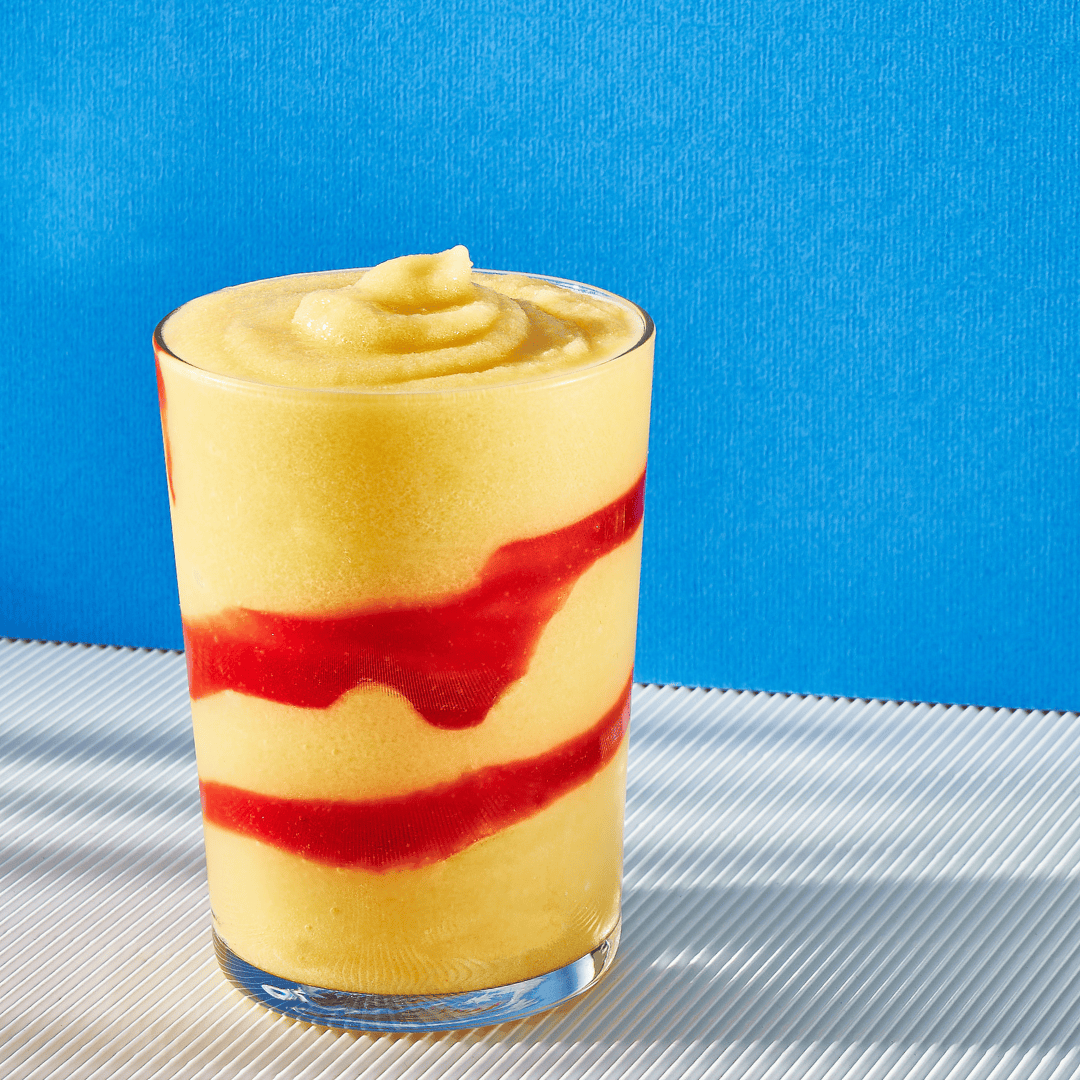
A great slushie looks effortless. Bright, frosty, holding a soft peak, pouring clean into the cup. The customer thinks it just happens. It does not. A perfect slushie is mostly chemistry and routine, and the operators who nail it do the same small things every shift.
Slushies have earned their spot up front. They are one of the highest-margin items most menus carry, they pull foot traffic because nobody can make a proper one at home, and the customers ordering them now read the label. That last part is the catch. The blue, artificially flavored version that built the category is on its way out, and real fruit is what people want in the cup.
This is the guide to getting there, whether you are pouring fruit slushies at a coffee counter or frozen cocktails off the back bar. Brix, balance, texture, and the open-to-close routine that keeps cup number 300 as good as cup number one.
Start with the mix, not the machine
Almost every slushie problem is a mix problem wearing a machine costume.
Here is the one thing to understand: sugar is the antifreeze. The dissolved sugar in your mix is what lets it freeze into soft, scoopable slush instead of a brick. Get it wrong in either direction and the machine cannot save you.
- Too much sugar and the mix never sets. It gets cold and stays liquid. Soupy syrup out of the tap.
- Too little sugar and it freezes hard against the cylinder walls, forms a block, and can snap the auger. That clicking noise is the auger fighting ice it should not have to.
The target is a Brix reading around 13 to 15 degrees, with most commercial machines tolerating a band of roughly 12 to 18 depending on the base. Brix is just the percent sugar by weight, and the only way to know yours is to measure it.
So measure it. A refractometer costs very little and ends the guessing. Build your mix, check the Brix, write the number down, and repeat it. Eyeballing is how you get a different slushie every day and a confused customer.
Where real fruit changes the recipe
Slush syrup is a flat, predictable sugar bomb. Real fruit is not, and that is the point.
A real fruit puree brings its own sugar, its own acid, and its own solids to the tank. That changes how you build the drink, and all three changes work in your favor:
- Acid balances the sweet. Real fruit has natural acidity, so a fruit slushie at the right Brix tastes bright instead of cloying. You can hit your sugar target without the drink going flat and candy-sweet.
- Solids give body. The pulp and fiber in a real puree build a smoother, rounder mouthfeel and help hold the slush texture, so it reads less like flavored ice.
- The color is the fruit. No FD&C dye to explain to a customer, which matters now that synthetic food dyes are being phased out of the supply.
One practical note. A puree is not as sugar-dense as a concentrated slush syrup, so you will dose more of it and then balance toward your Brix band with simple syrup or water. Oregon Fruit's Pourable Fruit makes this repeatable: it is shelf-stable, pours straight into the tank at ambient temperature, and lands at the same Brix and the same color batch after batch. Dose it, check your number, top to target, serve. No flat of berries to prep, no waste at close.
Pre-chill, then load
The step almost everyone skips. Start with cold mix.
A slush machine makes slush by pulling heat out of the tank. Pour in room-temperature mix and you have handed it a much bigger job, which means a longer freeze and a rougher texture. Fridge-cold mix freezes faster and finishes smoother. In a warm room it is the difference between perfect and soupy.
And do not overfill. Keep the bowl at least half full, but leave the auger room to move. A jammed, overpacked tank freezes unevenly and works the motor harder than it should.
Dial the texture for the counter
The texture you want holds a soft peak and still pours. Not a milkshake, not a snow cone. Somewhere a spoon stands up in but a straw still pulls.
The trap is drift. The first cup of the day and the cup you pour two hours into a rush should feel the same, and they will not if the bowl runs low and the mix keeps refreezing on itself. The fix is boring and it works: keep the tank topped up within your fill range so the texture stays stable. A bowl that is constantly run down to the dregs gives every customer a slightly different drink.
Make it boozy: frozen cocktails for the bar
Everything above still applies behind the bar. There is just one more variable, and it is the one that trips people up: alcohol is also an antifreeze.
Sugar lowers the freezing point, and so does alcohol. Put both in the same tank and you are balancing two things at once, in a narrower window than a non-alcoholic slush. Too much booze and the drink never sets, too little sugar and it freezes into a brick. This is why spirit-forward drinks like a Manhattan or a Martini simply will not slush, and why the frozen format belongs to juice-forward, fruit-forward drinks: margaritas, daiquiris, palomas, bellinis, frosé. The drinks built on citrus and fruit are the ones the machine likes, which is convenient, because they are also the ones real fruit makes better.
You don't have to do the math by hand. Jeffrey Morgenthaler, the Portland bartender behind The Bar Book, built the Simple Slushy Calculator at slushycalc.com, and it has become the tool much of the industry reaches for. You take an existing single-serving cocktail, measure its Brix with a refractometer, enter your machine's volume, and it scales the batch and tells you exactly how much simple syrup and water to add to land in slushable range. It also flags any recipe that is too high in alcohol to freeze, so you find out before you fill the tank instead of after.
This year Jeff also rolled the tool into Bevnap, a paid iPhone and iPad app that bundles the slushy calculator with batching, ABV, pour cost, and carbonation tools for running a full program. One tip from Jeff that catches people out, "Set your machine to maximum cold. Ignore smart presets."
This is where real fruit earns its place on a cocktail menu, not just a coffee menu. A frozen margarita built on real lime and a frozen bellini built on real peach or marionberry taste like the fruit, hold a better texture from the puree's body, and carry their own color. Pourable Fruit gives the bar the same thing it gives the cafe: a consistent, measurable input, so your house frozen marg is the same on a Tuesday as it is on a Saturday.
And the back-bar math is good. Spaceman USA, maker of commercial soft serve and frozen beverage machines, says frozen cocktails carry "a very high profit margin of around 65%-70%". And because you batch the tank ahead of service, the bartender is not stuck blending one drink at a time while a rail of tickets piles up. The machine pours in seconds, the drink is identical every time, and the same juice-forward builds work alcohol-free for the growing no-and-low crowd. A frozen cocktail machine on the back bar is also a draw in its own right. People order what they can see spinning.
Front of house is a visual category
A slushie sells with its face before anyone tastes it. The bowl is a billboard, and a churning wall of real strawberry or marionberry color does more marketing than a chalkboard ever will.
Treat the presentation like part of the recipe. A clear cup that shows the color. A clean pour with no drips down the side. A garnish if it fits the concept. These drinks get photographed, and a photogenic cup is free reach. Place the machine where the line can see it, because frozen drinks are an impulse buy and visibility is most of the sale.
The open-to-close routine that protects your margin
A frozen program is high-margin only if the machine stays healthy and the product stays consistent. That comes down to a short daily routine.
- At open: confirm the machine is in freeze mode, not the overnight chill or conservation setting. Plenty of "it won't freeze" panics are just a machine still in night mode. Check your Brix and fill level before the first customer.
- All day: keep the bowl topped within range, and keep the unit breathing. Leave clearance behind and around it, away from hot equipment, and keep the condenser clean so it can shed heat. A choked condenser kills performance fast.
- At close: switch to night or conservation mode so the mix holds cold overnight without freezing solid or spoiling.
- On a schedule: clean and sanitize thoroughly every week or roughly every 500 drinks, and replace rubber seals about once a year. This is food safety first, and a clean machine also simply makes better slush.
Quick troubleshooting
Mix won't freeze, stays soupy.
Brix is probably too high, or the mix went in warm, or the machine can't breathe. Check sugar level first, then airflow and ambient heat.
Freezes too hard, makes chunks or a block.
Brix is too low. The mix needs more dissolved sugar. Raise it gradually and recheck, rather than dumping in sugar all at once.
Clicking or knocking sound.
The auger is hitting ice it shouldn't. Usually the mix is too watery. Shut the machine off before the motor pays for it, then fix the ratio.
Texture drifts over the day.
You're running the bowl too low. Keep it topped within range so the slush doesn't keep refreezing on itself.
Slow to freeze on a hot afternoon.
Pre-chill the mix, clear space around the machine, and clean the condenser. Heat is the enemy of freeze time.
Boozy slush won't set.
There is too much alcohol for the sugar to overcome. Lower the ABV, raise the sugar, or run the recipe through the slushy calculator and let it tell you the fix. Set the machine to maximum cold.
Build a lineup that keeps people coming back
Most commercial machines run two tanks. Use them. Keep one familiar anchor flavor that always sells, and rotate a real-fruit feature on the other.
That rotation is where real fruit earns its keep. A seasonal feature tied to actual fruit, a marionberry in summer, a blood orange when people are planning for spring, gives regulars a reason to come back and check what's on. Limited-time flavors drive repeat visits in a way a static menu never will, and a real fruit feature reads as a genuine upgrade rather than a new syrup.
Behind the bar, the same logic runs on the cocktail list. A house frozen marg as the anchor, a rotating frozen feature alongside it: a real peach bellini, a marionberry daiquiri, a frosé when the weather turns. Build each one alcohol-free on request and you have covered the no-and-low crowd off the same menu.
// MADE IN OREGON SINCE 1935 //
Oregon Fruit Co. has spent a long time figuring out how real fruit behaves, in Salem, Oregon, since 1935. Our Pourable Fruits are built for people who make things and care how they turn out. They pour straight in, hold their Brix and color, and taste like the fruit on the label.
Dial in your mix, keep the bowl full, and let the fruit do the talking.